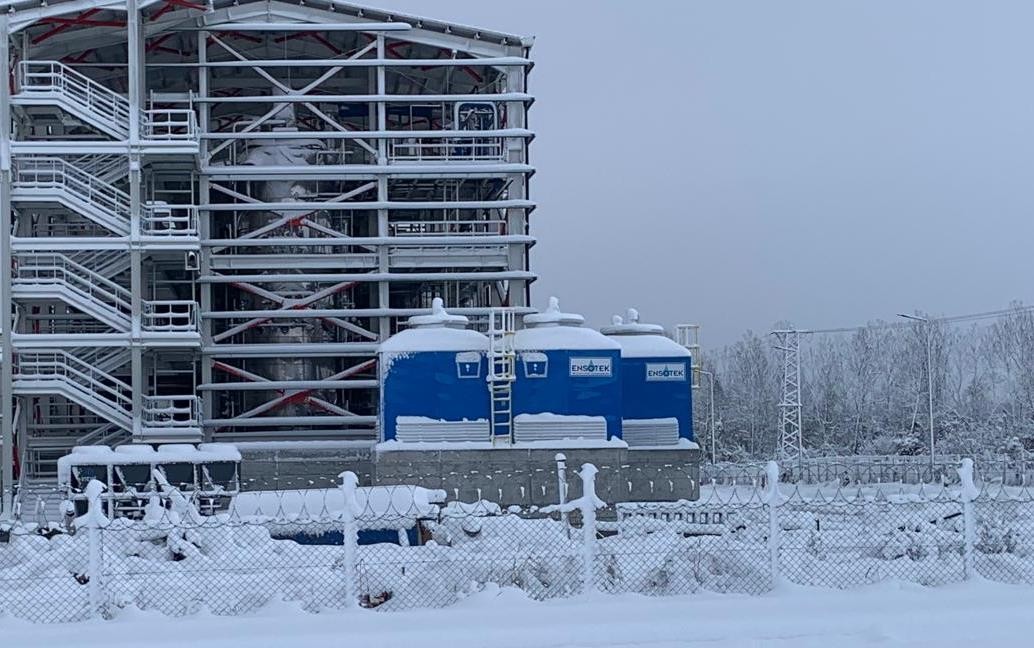
Cooling Tower Performance at Lower Ambient Temperatures
The cooling tower performance is fundamentally governed by the principles of heat and mass transfer and by the psychrometric properties of air. The cooling process in an evaporative cooling tower is driven by the difference between the water temperature and the ambient air wet-bulb temperature, which represents the thermodynamic limit of evaporative cooling.
According to the second law of thermodynamics, heat transfer requires a sufficient temperature and enthalpy driving force. In cooling towers, this driving force is defined by the difference between the circulating water temperature and the ambient wet-bulb temperature. The achievable approach (the difference between cold water temperature and wet-bulb temperature) becomes increasingly difficult to maintain as operating conditions move away from the design point.
From a psychrometric perspective, the cooling tower operates along a path where sensible and latent heat are exchanged between the water and the air stream. The evaporation of water into the air increases the air humidity ratio and enthalpy, following the saturation curve in the psychrometric chart. The effectiveness of this process depends strongly on the air’s initial enthalpy and wet-bulb temperature.
When ambient temperatures drop significantly, the thermodynamic equilibrium conditions between water and air change. Although colder air may have a lower wet-bulb temperature, the overall heat and mass transfer balance in the tower is altered due to factors such as reduced evaporation potential, airflow characteristics, and operational limitations required to prevent issues such as icing or unstable airflow.
For these reasons, under cold weather conditions the cooling tower may not maintain the same delta T or the same approach to the wet-bulb temperature as achieved under design summer conditions. The tower performance should therefore be evaluated based on seasonal operating conditions rather than assuming identical thermal performance throughout the year.
Seasonal Operating Performance of Cooling Towers
Industrial cooling towers operate under varying environmental conditions throughout the year. As ambient temperatures change between seasons, the thermal performance of cooling towers may vary compared to the original design conditions.
Cooling towers work based on the evaporative cooling principle, where heat is removed from circulating water through evaporation and air contact. The efficiency of this process strongly depends on the ambient wet-bulb temperature, which represents the thermodynamic limit of evaporative cooling.
Because of this dependency, seasonal weather changes directly influence the heat and mass transfer processes occurring inside the cooling tower.
The thermal performance of a cooling tower is typically evaluated using three main parameters:
Range (ΔT)
The temperature difference between the hot water entering the tower and the cold water leaving the tower.
Approach
The temperature difference between the cold water temperature and the ambient wet-bulb temperature.
Efficiency (Cooling Tower Effectiveness)
Indicates how closely the cooling tower approaches the theoretical maximum cooling potential.
These parameters are commonly expressed as:
Range = T_hot − T_cold
Approach = T_cold − T_wet bulb
Cooling tower performance is largely governed by the enthalpy difference between water and air, which determines the driving force for heat transfer.
During winter operation or low ambient temperature conditions, the operating behavior of cooling towers may change. While colder air can provide a lower wet-bulb temperature in theory, several practical operating factors influence actual tower performance:
Changes in heat and mass transfer balance between water and air
Variations in airflow characteristics
Operational limitations to prevent icing or freezing
Control adjustments in fan speed or water flow rate
Reduced process heat load during colder seasons
For these reasons, cooling towers may not maintain the same approach to wet-bulb temperature or the same delta T (range) under winter conditions as they do during summer design conditions.
Cooling towers operate according to the psychrometric properties of air. Inside the tower, a small portion of circulating water evaporates into the air stream. During this process:
the humidity ratio of the air increases
the air enthalpy rises
latent heat transfer occurs from water to air
On a psychrometric chart, this process can be represented as a path moving toward the saturation curve as the air absorbs moisture and heat.
From a thermodynamic perspective, heat transfer requires a sufficient temperature and enthalpy difference between two mediums. Seasonal environmental changes modify these conditions and therefore influence cooling tower performance.
Cooling towers are typically designed based on peak summer operating conditions, when ambient temperatures and wet-bulb temperatures are highest.
During actual plant operation throughout the year, however, several factors may vary:
ambient air temperature
wet-bulb temperature
process heat load
airflow and water flow conditions
Because of these variables, seasonal variations in cooling tower performance are expected and should be considered when evaluating system operation.
A properly designed and well-operated cooling tower system provides several important advantages:
improved energy efficiency
extended equipment lifetime
stable process cooling performance
reduced maintenance requirements
For optimal performance in industrial applications, cooling towers should be evaluated using proper engineering calculations, seasonal operating analysis, and performance monitoring.